
Trumbull County City Directory Holdings
The most useful starting point is the documented sequence in the Ohio Genealogical Society accession list, followed by a catalog or desk check at the Warren-Trumbull County Public Library Local History & Genealogy Center. WTCPL confirms that Warren directories are part of its local collections, yet its public pages do not publish a complete title-by-title shelf run. That distinction matters. The table identifies verified editions and tells a researcher where to begin, rather than claiming that every listed volume is on a particular shelf.
| Collection | Years | Where Held | Access |
|---|---|---|---|
| Warren, Niles, Girard and Newton Falls, Ohio City Directory, Burch | 1930-31; 1932-33 | Ohio Genealogical Society accession list; confirm local copy with WTCPL | Catalog or research-desk confirmation |
| Warren, Niles and Newton Falls, Ohio City Directory, Burch | 1937; 1938-39 | Ohio Genealogical Society accession list | Use the regional title when locating a household |
| Warren, Niles, Newton Falls, Girard and McDonald, Burch | 1942, 1951, 1953, 1957, 1959, 1965, 1967 | Ohio Genealogical Society accession list; WTCPL referral | Compare nearby editions in the series |
| Warren, Niles, Newton Falls and Cortland, Burch | 1976; 1978 | Ohio Genealogical Society accession list | Later regional coverage, not a Warren-only label |
| Warren Ohio City Directory, Polk | 1989, 1990, 1991-92, 1993, 1995, 1996 | Ohio Genealogical Society accession list; check WTCPL catalog | Warren-specific printed-run leads |
| Youngstown-Warren-Niles City and Suburban Criss + Cross Directory, Haines | 1997 | Ohio Genealogical Society accession list; ask WTCPL about access | Reverse address format, address to listed occupant |
Warren material does not always carry a Warren-only title. The Burch sequence changes its companion communities across decades, so a name absent from one title may appear in a regional neighbor edition. WTCPL also holds local-history books, periodicals, microfilm, databases, public computers, and microfilm readers. Its collections focus on Trumbull County, Ohio, and places from which early Ohio residents migrated.
Note: A missing year in the public list calls for a catalog or desk question, not an assumption that no directory was printed or retained.
WTCPL Trumbull County Directory Desk
The WTCPL Local History & Genealogy Center is on the second floor of the Warren Library at 444 Mahoning Avenue NW. Published hours are Monday through Thursday from 9 a.m. to 8 p.m., Friday and Saturday from 9 a.m. to 5 p.m., with Sunday closed. Closed-stack archival material should be requested ahead. The library warns that same-day access may not be possible when only one staff member is on duty. A focused Book-a-Librarian session or research request is more effective than a broad request to find an entire family.
Its online research resource list documents in-library Ancestry Library Edition, African American Heritage, Fold3 Library Edition, HeritageQuest, Sanborn Fire Insurance Maps through Ohio Web Library, and Trumbull Memory. Those tools are useful companions to city directories, but the library should confirm current availability and what a particular database displays.
See the library's Local History & Genealogy Center before arranging a visit.
The library image reinforces why a desk or catalog check is part of directory research when a public web page does not list each printed volume.
Burch City Directories Across Communities
The Burch titles provide a practical lesson in regional labeling. The 1930-33 editions join Warren, Niles, Girard, and Newton Falls. The 1937 and 1938-39 titles omit Girard from the title, while the 1942 through 1967 sequence includes McDonald. By 1976 and 1978, the documented title combines Warren, Niles, Newton Falls, and Cortland. A researcher should copy the full title, publication year, and community label from every result. Those details explain why a surname search may need a different volume even when the household remained in Trumbull County.
The county includes 24 townships, six cities, and five villages. That local geography makes a place label more than decoration. Keep the township or city, subdivision name, and address together in research notes. A postal label and a municipal jurisdiction can differ, and historic volumes organize people according to the title's regional logic.
Note: A directory's listed address establishes a dated connection to that edition, not a complete account of a household or its legal ownership.
Reading Trumbull County City Directory Entries
An accessible index record for a Warren, Ohio, City Directory dated 1925 shows the kind of fields that can be extracted without guessing at the printed page. The observed inventory includes a name, residence year, street address, residence place, occupation, and publication title. That is enough to create a careful research note and locate the correct edition. It does not establish that every printed Warren entry used the same abbreviations or carried a spouse, owner, renter, or widow notation.
| Entry element | What the observed index can show |
|---|---|
| Name | Record the spelling exactly, including initials or a middle name if printed. |
| Residence year | Marks the directory year associated with the indexed listing. |
| Street address | Copies the address as printed, then compare it with maps and later records. |
| Residence place | Preserves the regional place label used by that edition. |
| Occupation | The accessible Warren index showed an occupation field, including an observed “Works” value. |
| Publication title | Identifies the source edition and prevents a regional book from being mistaken for a Warren-only volume. |
| Owner, renter, spouse, or abbreviation marks | Not verified in the observed scanned Warren evidence. Inspect the original volume's title page and key before interpreting any mark. |
- Criss-cross directory
- A reverse directory arranged by address so a researcher can move from a listed street location to a listed occupant.
- Householder index
- An index intended to lead to a household or head-of-household listing, if that edition provides one.
- Abbreviation key
- The volume's own explanation of shorthand. Photograph or transcribe it before decoding residence or relationship marks.
A directory image, title page, and index entry should stay together in a research file. The digitized index is a lead; the actual edition controls how its abbreviations are read.
Trumbull County's 1997 Criss-Cross
The verified 1997 Haines title, Youngstown-Warren-Niles City and Suburban Criss + Cross Directory, is distinct because it runs from address to listed occupant. That makes it useful for historical address work after the right street number and community have been established. It is not a substitute for a current parcel record, and it cannot prove that every person at an address was part of the household.
For a present-day address chain, the county's modern address tools belong on the Trumbull County streets reference. The criss-cross volume is the historical bridge. Use it to identify a listed name, then compare the entry with a nearby regular directory year, a census, an obituary citation, or a recorded document.
Tracing Trumbull County City Directory Families
Household tracing works by placing each directory result in order and testing it against independent records. Start with the full regional title, not just the word Warren. When a person moves, write down the old and new address exactly as printed. The 1850 through 1950 federal census schedules generally name each household member, though census address precision varies. That makes census a useful companion rather than a clean parcel lookup.
- Find the first known name or address in the closest verified directory edition and copy its complete title, year, and community labels.
- Check the earlier and later available editions in the same Burch, Polk, or Haines sequence, noting spelling changes, address moves, and changed regional coverage.
- For a 1997 address, consult the Haines criss-cross listing and compare it with a regular directory rather than treating one listing as final proof.
- Pair each directory period with the appropriate public census, then use its household detail to test the time and place association.
- When the person disappears, search obituary, probate, newspaper, map, or recorded-transfer evidence for a move, death, or changed address.
A disappearance has several possible causes. The person may have moved, died, been omitted, changed a name, or fallen outside a new regional title. A modern record can help verify a current identity, but the historical sequence should remain tied to its original sources.
Trumbull County Obituaries Beside Directories
WTCPL's Warren Tribune Chronicle Obituary Index can close gaps between directory years. Its online database covers 1961-2025. Online PDF index runs cover 1900-10, 1911-19, 1920-29, 1930-39, 1940-44, and 1945-49, while printed index resources cover 1900 to the present with scattered years from 1812 to 1900. Trumbull County newspaper microfilm is available from 1812 to the present, excluding Sundays.
One local indexing quirk deserves attention. An all-caps surname is the surname used at death, while mixed case can signal a maiden or prior married surname as printed in the obituary. Search both versions when a directory name vanishes. The library asks for a death date and accepts up to five citations per request, so a narrow citation request is preferable to a sweeping name search.
See WTCPL's obituary search index for the local index route.
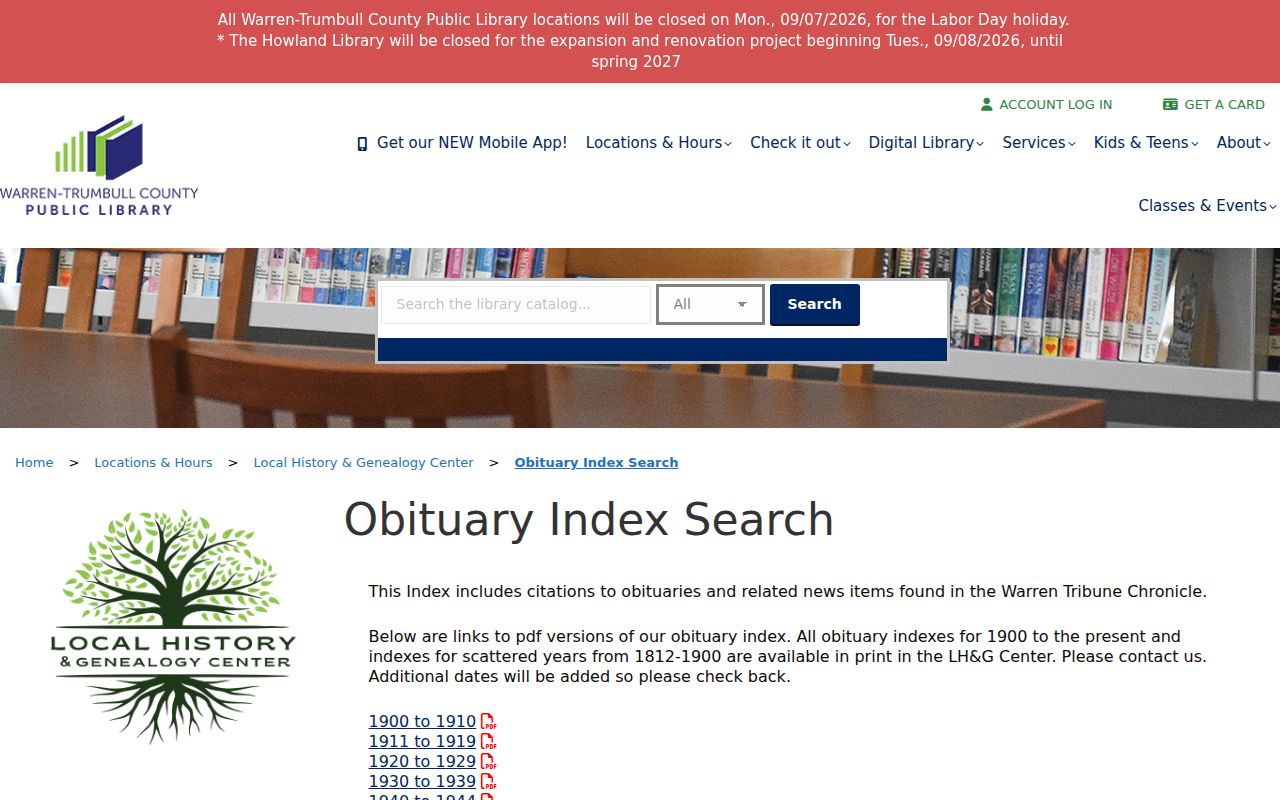
The obituary index can supply a date and surname form to test against a directory's final known listing.
Note: An obituary and a directory can corroborate a time period, but each still needs to be read as the record type it is.
Trumbull Memory's Address Clues
WTCPL digitized resources include incomplete volunteer-card-file transcriptions for adoptions, divorces, marriages elsewhere, and naturalization. They are leads, not complete legal indexes. The same resource page offers the 1918 Atlas of the Ten Lower Townships of Trumbull County, Ohio, with a Warren street and industrial map plus a Morgandale Little Farms plate. Those maps can connect an older place or subdivision label to a legal description.
The 2024 redesign of Trumbull Memory made its archive searchable by location, subject, year, or name. It is not a directory, but its local records can explain a changed address. One item documents Adams Express at 39 E. Market in 1899, 17 E. Market from 1902 through 1912, and 127 E. Market by 1914. Another describes a 1900-01 location later converted from 106 to 245 Tod Avenue. These are individual continuity clues, not proof of a countywide numbering change.
Use the library's digitized local resources to locate these maps and index leads.
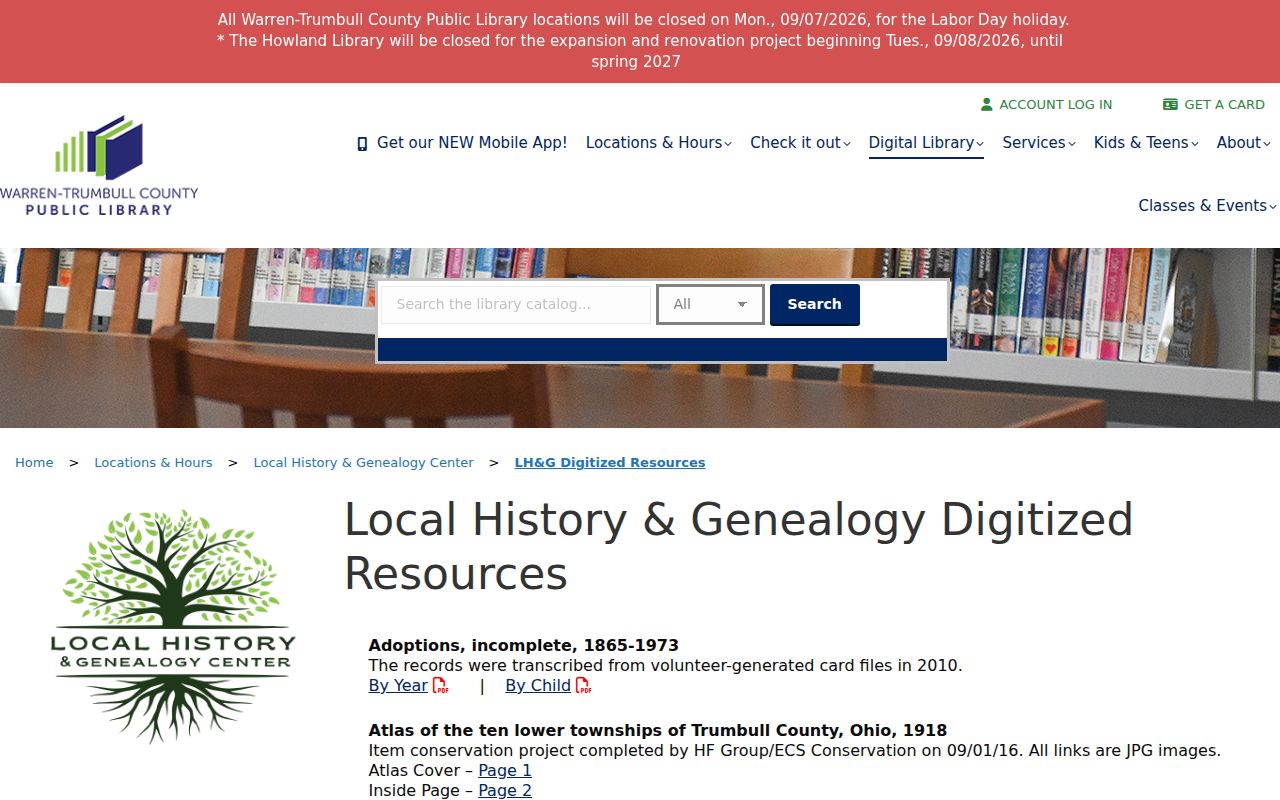
Historic maps and directory citations work together when an older street number no longer matches a present address.
Trumbull County Historical Collections
The Trumbull County Historical Society online database offers a separate route for historical context. Its CatalogIt search supports person, date, place, and tag, and the society reports more than 30,000 items with more than 13,000 archival items. Letters, ledgers, photographs, organizational records, family material, books, journals, and newspaper material may help confirm a person, place, or institution from a directory. Some physical material requires an appointment.
Ohio Memory also describes a TCHS collection of 15,000 to 20,000 historical items about Trumbull County and the Connecticut Western Reserve. Pair a catalog result with its collection description, then arrange research access if the record itself is not online. This is historical association evidence, not a current directory.
Review WTCPL's online genealogy resources for the local tools that complement directory and collection research.
Collection searches add local documents and images that can support, but not replace, a dated directory entry. The Historical Society's CatalogIt collection search is a separate route for a person, place, date, or tag query.
Trumbull County Directory Research Timeline
Local record history cautions against a simple, uninterrupted shelf story. The second courthouse on Warren's square burned on March 25, 1895, but the official history does not establish that every older record series was lost. Surviving Recorder and Archive materials reach much further back. Directory research is strongest when it identifies a specific edition and uses the library, archives, maps, and newspaper channels around it.
| Year | Directory and local-record event |
|---|---|
| 1895 | Warren's second courthouse burned. The event is real, but it does not justify a blanket claim of total records loss. |
| 1930-33 | Verified Burch regional directory editions join Warren with Niles, Girard, and Newton Falls. |
| 1942-67 | Verified Burch titles include a regional sequence with McDonald. |
| 1976-78 | Verified Burch titles use a Warren, Niles, Newton Falls, and Cortland combination. |
| 1989-96 | Verified Polk Warren titles provide later printed-run leads. |
| 1997 | The verified Haines criss-cross title supplies a reverse address route. |
| 2024-25 | Trumbull Memory was redesigned, and an Ohio History Fund grant supported preservation and transcription of Warren historical artifacts. |
The best final citation names the edition, page or entry, year, repository, and any companion source used to interpret it. That practice makes a Trumbull County directory trail checkable when later records add a different spelling or address.